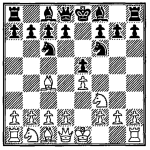
SICILIAN DEFENSE →
1. e4 c5
♟
From Modern Chess Openings →
“The Sicilian Defense is Black’s most popular defense to 1. e4 for both serious amateur and professional players. The opening is active and unsymmetrical, as well as positionally sound. Kasparov and Fischer were devotees of the opening, though all World Champions of the last hundred years have used it at least fairly extensively. Kramnik, Anand, Topalov, and Carlsen are some of the other adherents.
The opening dates back to Italy more than four hundred years ago. It was mentioned by Polerio in 1594 and given its name by Greco early in the next century. The match between MacDonnell and La Bourdonnais in 1834 greatly helped the chess world appreciate the virtues of the Sicilian, which requires some sophistication to think of playing, as the strategy is not initially obvious.
With 1…c5, Black stakes out territory in the center, denying White the pawn duo of e4 and d4. The Black d- and e-pawns will later advance to control key squares, but their early presence around the king allows Black to blunt any quick attack. White’s most effective plan is to open the game with d4 (after Nf3), gaining space and opening lines. After …cxd4, Black has an open c-file for counterplay, along with two center pawns that play their initially defensive role. The positions arising are asymmetrical, which has the appealing aspect of local imbalances on the board. Frequently, White will have pressure on one area of the board and Black on another area—such as the typical White kingside attack vs. Black’s queenside counterplay. Thus, the games tend to be lively, with fierce struggles and winning chances for both sides. The lively play, combined with the inherent soundness of the defense, is the reason for the Sicilian’s popularity.
This chapter is large, as there are many variations of the Sicilian that differ significantly in strategy and positional structure. Therefore, the chapter is broken up into subchapters of major variations or similar variations. These subchapters are:
The NAJDORF VARIATION
The DRAGON VARIATION (and Accelerated Dragon)
The SCHEVENINGEN VARIATION
Systems with 2…e6 — TAIMANOV VARIATION, PAULSEN VARIATION, and FOUR KNIGHTS’ VARIATION
Classical Sicilian — RICHTER–RAUZER ATTACK, BOLESLAVSKY VARIATION, and SOZIN–VELIMIROVIC ATTACK
Systems with …Nc6 and …e5 — SVESHNIKOV (PELIKAN) VARIATION, KALASHNIKOV and LÖWENTHAL VARIATIONS (and 4…Qb6)
Non-open systems (lines without 2. Nf3 and 3. d4) — CLOSED SICILIAN, 2. c3 Sicilian, 3. Bb5 variations, the f4 Attack, Unusual Second Moves.”
♟
IF/THEN/ELSE →
The Sicilian Defense is the most popular response to 1.e4—and it’s not just about theory. It’s about creating imbalance, surprise, and real winning chances. If you’ve ever wondered why everyone plays it, or how to make sense of the many variations, this is your map.
Instead of just memorizing lines, I’ll walk you through the logic of the Sicilian—what to do depending on what your opponent plays. Think of it like a chess decision tree.
Opening moves:
1. e4 c5
If you are Black and White plays 1. e4,
then respond with 1…c5.
→ This is the Sicilian Defense.
If you play 1…c5, then you challenge central control without mirroring 1. e4, and you prevent White from easily playing d4 and building a strong center with pawns on e4 and d4. Else (if you play symmetrical 1…e5), then White can more easily steer the game into classical open game territory.
If you choose the Sicilian Defense, then you are entering an asymmetrical position, which increases dynamic chances and winning possibilities for both sides. Else you are likely playing a more equal, symmetrical opening with fewer imbalances.
If White plays 2. Nf3,
then you must be prepared for the Open Sicilian (after 3. d4).
→ This is the most aggressive and theoretical continuation.
Else if White plays a quieter move like 2. Nc3, 2. c3, or 2. d3, then you’re in a Closed Sicilian or Anti-Sicilian, which leads to different structures and strategic goals.
If White continues with 3. d4 and you respond 3…cxd4, then you trade your flank pawn for White’s central pawn. → This opens the c-file for your rook and gives you long-term queenside counterplay. And you aim for dynamic piece play and control of key central squares with your e- and d-pawns.
If you want a sharp and theoretical battle as Black, then choose one of the main variations:
VARIATION PATHWAYS – CHOOSE BASED ON STYLE
If you prefer active piece play, tactical fireworks, and deep theory,
then consider the NAJDORF VARIATION:
1. e4 c5 2. Nf3 d6 3. d4 cxd4 4. Nxd4 Nf6 5. Nc3 a6 → Flexible and powerful, this line allows for many ideas: …e5, …e6, …g6, …b5.
If you enjoy sharp attacking games with castling opposite sides and a focus on king attacks, then play the DRAGON VARIATION:
1. e4 c5 2. Nf3 d6 3. d4 cxd4 4. Nxd4 Nf6 5. Nc3 g6 → You fianchetto your bishop and strike with …Bg7, pressuring the center and kingside.
Else if you prefer slightly more solid yet dynamic play,
then opt for the ACCELERATED DRAGON:
1. e4 c5 2. Nf3 Nc6 3. d4 cxd4 4. Nxd4 g6
→ You delay …d6 to keep …d5 in one go, aiming for faster central control.
If you like solid central control and flexibility,
then consider the SCHEVENINGEN VARIATION:
1. e4 c5 2. Nf3 d6 3. d4 cxd4 4. Nxd4 Nf6 5. Nc3 e6
→ You prepare to develop pieces harmoniously, support …d5, and counterattack later.
STRATEGIC THEMES
If White castles kingside and starts a kingside pawn storm (as in many main lines),
then plan counterplay on the queenside—especially using the open c-file and pawn breaks like …b5, …a5, …b4.
If White delays d4 and plays setups like 2. Nc3 or 3. Bb5+, then prepare for positional maneuvering and structure control.
If you’re new to Sicilian theory, then pick one main variation to study deeply, else you risk being outprepared in sharp lines.
♟
Sicilian Defense
(Main Line – Najdorf Structure)
1. e4 c5
2. Nf3 d6
3. d4 cxd4
4. Nxd4 Nf6
5. Nc3 a6
Common 6th moves and replies:
6. Bg5 → 6…e6
6. Be2 → 6…e6
6. Bc4 → 6…e6
6. f4 → 6…e6
6. Be3 → 6…e6 or 6…e5
6. h3 → 6…e5
Typical follow-up plan:
7. Be2 (or f3) Be7
8. O-O O-O
9. f4 Qc7
10. Kh1 Nbd7
11. a4 b6
12. Bf3 Bb7
13. Qe1 Rfe8
14. Qg3 Bf8
15. f5 e5
This line leads to a typical Najdorf middlegame, where Black plays on the queenside with …b5, …Bb7, and prepares …d5 or …e5 breaks depending on White’s setup.
♟
What happens when the Sicilian Defense works well? →
Asymmetry becomes an asset:
The Sicilian creates imbalanced positions by design. Over time, this leads to rich middlegame complexity and unbalanced endgames, increasing winning chances for both sides—especially Black, who avoids early equality.
Counterplay is built-in:
Black concedes initial space but gains long-term activity. The open c-file, delayed central tension, and queenside expansion give Black multiple systems of counterattack—especially in Najdorf, Dragon, and Sveshnikov setups.
Theory-heavy = preparation advantage:
The Sicilian rewards players who invest in study. Over time, it builds a deep familiarity with sharp tactical patterns and recurring pawn structures, giving seasoned players a clear edge.
Engine-tested soundness:
The Sicilian holds up against modern analysis. At the systemic level of opening theory, it’s one of the most resilient defenses to 1.e4. Even with best play from both sides, Black’s chances remain dynamic and viable.
Mental and stylistic alignment:
Over many games, players who thrive in calculated, strategic warfare (rather than passive defense) find the Sicilian fits their style. It becomes more than a system—it shapes how one plays chess.
Long-term statistical performance:
Across master and engine games, the Sicilian has some of the highest win rates for Black among all 1.e4 defenses. It doesn’t just survive—it frequently strikes back.
In the Spirit of Adventure, The Guide