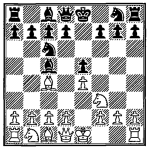
1 e4 e5 2 f4
”
THE KING’S GAMBIT seeks to clear away Black’s central pawn to build HIS (her) own dominating center. The possibilities on the open f-file and mating attacks against f7 have resulted in many brilliant victories for the White side. In the early 1600s, Gioachino Greco won many wonderful games, giving the opening a strong reputation. The view that the King’s Gambit was a bold, courageous, and sound opening persisted for more than two centuries.
The mid-nineteenth century brought a dawning awareness that some gambit lines were probably unsound—more likely to lead to a forced loss than a forced win. Players then began to seek positional rather than tactical benefits from an opening. By the time of the first official World Championship match between Steinitz and Zukertort in 1886, the King’s Gambit was already in eclipse; the six World Championship matches played between 1886 and 1896 featured only a single King’s Gambit.
In the twentieth century, chess saw a great leap in positional understanding, exemplified in the rigorously sound play of the great World Champion José Capablanca. Capablanca and others were disdainful of the speculative King’s Gambit, and regard for the opening sank further. Bobby Fischer’s famous article from the 1960s, “A Bust to the King’s Gambit,” should have put the opening to rest—yet it has refused to die.
There are always adventurous tactical players who revel in the wild positions that occur. Many of the greatest players of the twentieth century found occasion to use it—Alekhine, Keres, Tal, Fischer (despite his article), and Spassky, who scored truly brilliant victories with it. In the early twenty-first century, most grandmasters use the King’s Gambit only as a surprise weapon, though Fedorov still makes regular use of it. Players cannot count on an opening advantage with the King’s Gambit, but they can certainly count on a lively game—where often both kings come under fire.
Black has four ways to react to 2. f4:
(1) Accept and hold the pawn;
(2) Accept and return the pawn;
(3) Decline the pawn;
(4) Offer a countergambit.
Columns 1–24 deal with 2…exf4. The first six columns cover 3…g5, supporting the f4 pawn and gaining kingside territory. These columns include the Kieseritzky, Philidor, Hanstein, and Muzio lines, of which the Kieseritzky Gambit sees more use today.
Black’s less common third moves are the subject of columns 7–12. These include 3…d6 (the Becker Defense), 3…Ne7, and 3…Nf6. The first two of these are particularly reasonable choices.
Black returns the pawn immediately with 3…d5 4. exd5 (columns 13–16). With 3…Be7 (columns 17–18), Black prepares to deliver check on h4.
Moves other than 3. Nf3 are covered in columns 19–24, including the King’s Bishop Gambit, 3. Bc4 (columns 19–20). In these lines, White allows …Qh4+, but the check is double-edged since the black queen may lose time retreating.
Black refuses the pawn and gambits one himself with the vigorous 2…d5, the Falkbeer Counter-Gambit (columns 25–30; see diagram above). The idea is to develop quickly and take advantage of the weakening of White’s kingside caused by 2. f4. Both 3…e4 and Nimzovich’s 3…c6 are investigated.
The choice of this countergambit may stem from psychological or stylistic preferences. Some players love to seize the initiative, and it can be more unsettling to defend a pawn up than to attack a pawn down.
The King’s Gambit Declined is covered in columns 31-36. The usual move to decline the gambit is 2… Bc5, see above diagram (columns 31-35), as White would lose immediately after 3 dxe5? Qh4t. Declining the gambit avoids wild tactics and complications, but gives White more chances for the advantage than the gambit accepted lines.
“
From “Modern Chess Openings”
—
KING’S GAMBIT
WHITE
You play:
1. e4
Opponent plays:
1… e5
You play:
2. f4 ← King’s Gambit
Now, if they accept:
2… exf4 ← King’s Gambit Accepted
Then you have a few ways to continue:
* If you play 3. Nf3 g5 4. h4 g4 5. Ne5 — you’re going into the Kieseritzky line.
* If you go 3. Nf3 g5 4. Bc4 g4 5. O-O — that’s the Muzio line.
* If Black plays a specific move to defend, and you follow a certain plan, it might become Philidor or Hanstein, depending on the path.
Kieseritzky, Philidor, Hanstein, Muzio, etc., in the first sequence of 6 diagrams in Modern Chess Openings, are named ways to continue your own opening (if you’re playing White) depending on how the opponent responds. They are not separate openings — they are specific follow-up plans (paths) within the King’s Gambit opening.
King’s Gambit Accepted — 4 named Variations
♟️ Kieseritzky Gambit
1. e4 e5
2. f4 exf4
3. Nf3 g5
4. h4 g4
5. Ne5
6. Bc4 d5
7. exd5 Bd6
8. d4 Nf6
9. Bxf4 O-O
10. O-O
11. Nc3
♟️ Philidor Gambit
1. e4 e5
2. f4 exf4
3. Nf3 g5
4. Bc4 Bg7
5. h4 h6
6. d4 d6
7. Nc3 Nc6
8. hxg5 hxg5
9. g3 Bg4
10. gxf4 Qd7
♟️ Hanstein Gambit
1. e4 e5
2. f4 exf4
3. Nf3 g5
4. Bc4 Bg7
5. O-O
6. d4 h6
7. c3 Nc6
8. Qb3 Qe7
9. e5 dxe5
10. dxe5
♟️ Muzio Gambit
1. e4 e5
2. f4 exf4
3. Nf3 g5
4. Bc4 g4
5. O-O
6. d4 gxf3
7. Qxf3 Qf6
8. e5 Qf5
9. Bxf4 Nc6
10. Nc3
The King’s Gambit Declined (KGD) and Falkbeer Counter-Gambit are both responses for Black.
King’s Gambit Declined (KGD) (1–9)
This is the sequence for the King’s Gambit Declined, where Black declines the gambit and instead focuses on solid development:
This is Black’s response to White’s King’s Gambit, where Black refuses to accept the pawn on f4. Instead, Black typically plays d6 or other solid moves, maintaining a strong pawn structure.
1. e4 e5
2. f4 exf4
3. Nf3 d6
4. d4 Nc6
5. Bxf4 Bg4
6. Nc3 Nf6
7. h3 Bxf3
8. gxf3 Be7
9. Qd2 O-O
Falkbeer Counter-Gambit (1–10)
The Falkbeer Counter-Gambit begins after Black counters White’s gambit by offering a gambit of their own:
This is another Black response to the King’s Gambit, but in this case, Black accepts the gambit and then offers a counter-gambit of their own with g5, challenging White’s central pawns and attempting to destabilize White’s position.
1. e4 e5
2. f4 exf4
3. Nf3 g5
4. d4 (the key move of the Falkbeer Counter-Gambit)
5. exf4
6. Nc3 Bg7
7. h4 g4
8. Ng5 h6
9. Nge4 Qe7
10. Bxf4
In the Spirit of Adventure, The Guide