10 Stages of Body Intelligence
Rosemary Anderson’s Body Intelligence Scale: Purifying Templates of Consciousness
Rosemary Anderson, from the Institute of Transpersonal Psychology in Palo Alto, Canada, is one of the developmental psychologists who has explored the somatic dimensions of transpersonal maturity.
In contrast to many other theories of human development, Rosemary states that these levels should primarily be based on bodily experience and maturity—something that often goes unacknowledged. This is about embodying developmental theory from a perspective that Western culture often overlooks.
This text presents a theory of the body’s role in human development in the form of the bodymap, compared with Cook-Greuter’s 9 Levels Of Increasing Embrace In Ego Development. This map is an attempt to put into words the embodied intuition that different levels of bodily awareness grant us.
“You do not have to be good.
You do not have to walk on your knees
for a hundred miles through the desert, repenting.
You only have to let the soft animal of your body
love what it loves.”
— Mary Oliver, Wild Geese
“For God’s sake, you have more strength in your teeth and more scents in your rump than Hercules himself had in his entire body and soul.”
— François Rabelais, Gargantua and Pantagruel
“There is more wisdom in your body than in your deepest philosophy.”
— Friedrich Nietzsche
The Ten Axes of Bodily Intelligence
→ Axis 1: The Archetypal Body — Facet 72
→ Axis 2: The Vigilance Body — Facet 73
→ Axis 3: The Pleasure Body — Facet 74
→ Axis 4: The Belonging Body — Facet 75
→ Axis 5: The Competent Body — Facet 76
→ Axis 6: The Compassionate Body — Facet 77
→ Axis 7: The Present Body — Facet 78
→ Axis 8: The Aware Body — Facet 79
→ Axis 9: The Awakened Body — Facet 80
→ Axis 10: The Enlightened Body — Facet 81
Axis 1: Archetypal Body — FACET 72
Primary Activity: Generating genetic, neonatal, perinatal imprints in consciousness. Depending on the reader’s belief systems, imprints also include karmic imprints. Overestimating the force of these impressions on the formation of our physical constitution, personalities, and life is impossible. As most mothers will say, every baby is different from birth, even from conception.
Embodiment Stance: Absorbing imprints prior to physical birth and sometimes for weeks or months thereafter.
Healthy Expression: The vast majority of our genetic, neonatal, and perinatal imprints are subliminal or unconscious to ordinary, day-to-day awareness. Subliminal means below perceptual threshold. Probably because I was trained in experimental social psychology in graduate school, I prefer the term subliminal to the term unconscious because it reflects my experience that awareness of archetypal imprints slips both below and above perceptual awareness in a seemingly unpredictable way. The vast amounts of psychoanalytic and Jungian literature and tantric spiritual practices originating in Asia have taught us a great deal about access to such subliminal or unconscious perceptual processes. Healthy adult expression requires, sometimes quite dramatically, a willingness to digest information arising from subliminal or unconscious processes with a certain modicum of well-being and physical health. There is no doubt that sharply arising impressions from subliminal or unconscious processes can be disorienting even to most healthy-minded people. A healthy response to these experiences may be to seek help from psychotherapists attuned to spiritual issues and spiritual guides who have experienced these states for themselves.
Unhealthy Adult Expression: Perhaps it will come as no surprise to those who read US newspapers that some of our political leaders are driven by archetypal processes about which they have little or no awareness. In transpersonal and spiritual circles, I have also known individuals who are so open to archetypal impressions that they are unable to conduct the day-to-day tasks of life.
Developmental Comparison: From a developmental perspective, only Stanislav Grof (1975, 1985) and Jenny Wade (1996) explore pre- and perinatal experiences in depth.
Forward Development: The transition from Axis 1 to Axis 2, Vigilance Body, occurs at birth or shortly thereafter. Some babies, especially those with challenging births, do not seem to fully embody their essence into their physical bodies for weeks or months—even up to a year—after birth.
Return Cycle: Reconfiguring and refining the archetypal patterns of this life occurs in the final stages of psycho-spiritual development in the Return Cycle of Axis 10, Enlightenment Body. Individuals experiencing this Return Cycle are among the “living dead,” sharing their illumination with others spontaneously and fearlessly, and are refining archetypal imprints in preparation for whatever comes after death. If we do not do this important work while we are alive, we will do it in what Tibetan Buddhists call bardo or Christian mystics call hell and purgatory. Completing this process now is highly recommended. Return Cycles are overviewed in the section entitled Return Cycles of Transformation below. Experiences of archetypes (templates of consciousness) can occur in any axis without necessarily indicating an Axis 1–Axis 10 Return Cycle.
Axis 2: Vigilance Body — FACET 73
Primary Activity: Avoiding pain, distress, and death.
Embodied Stance: Constantly on alert and vigilant.
Healthy Expression: Relaxed and aware physical bearing, capacity to focus attention when danger is present or likely, and active exploration of the world appropriate to age. Health is marked by an increased willingness to explore the external environment and a capacity to feel wonder and delight at any age. Being fearful and vigilant are appropriate to immediate circumstances.
Unhealthy Expression: Chronic hyper-vigilance and chronic arousal results in over-stimulated sympathetic nervous system. Symptoms of post-traumatic stress may be evident at any age, even in babies. Somatic and psychic energies are consumed by self-preservation and restricted or distorted perceptual reality. Unhealthy expression is marked by fear in response to external change and a reticence to explore the world in a manner appropriate to age. As a consequence of traumatic births or infant abuse, some adults may be unrecognized trauma victims who remain chronically fearful, constantly watching for signs of danger, and easily reduced to feeling terrorized by minor provocations. Most adults have experienced frightful events in life, such as accidents or extreme illness. Recovery from emotional trauma may take longer than recovery from the physical injury itself. If we are traumatized often or severely, it may take years to tame our now hyper-vigilant sensorial alarm systems in order to trust the world as we once did.
Developmental Comparison: Axis 2 development characterizes most infants during the first few months of life. Between months 5 and 9, healthy babies begin a process of bodily differentiation from mother, known to researcher Margaret Mahler (1975) as “hatching.” Hatching from fused identity with mother signifies the transition from Axis 2 to Axis 3, Pleasure Body. Axis 3 is fully realized in emotional and libidinal differentiation from the mother, occurring between months 15 and 24 in healthy development. Axis 4 is more or less parallel to Cook-Greuter’s Stage 2, Impulsive.
Forward Development: Transition to Axis 3, Pleasure Body, is marked by a willingness to relax one’s guard and explore the world. The sympathetic nervous system is no longer over-stimulated by real or inchoate threats to one’s physical well-being. Hyper-vigilance and fear of the unknown relax over time, albeit gradually. Physical stance is alert but more relaxed. No longer needing to maintain high alert for threats to one’s physical safety, life energies begin to focus on exploring the world, attending to novel stimuli, broadening one’s perceptual reality, and reciprocating in response to touch, attention, and affection from others.
Return Cycle: Overcoming the impressions and urgency of vigilance and concern for self in Axis 2 is the transformational task of Axis 9, Awakening Body. Return Cycles are overviewed in the section entitled Return Cycles of Transformation below.
Axis 3: Pleasure Body — FACET 74
Primary Activity: Seeking pleasure and delight.
Embodied Stance: Readiness for pleasure, delight, and play.
Healthy Expression: Able to relax and move gracefully, feel secure and comfortable even under difficult circumstances, feel pleasure, use internal body sensations as a source of information and intuition, give and receive affection, comfort oneself physically and emotionally during times of stress and hardship, and explore the world with a sense of wonder and curiosity. In learning what is pleasurable and what is not, we learn the rudiments of somatic and psychological resilience. The differences between what is pleasurable and what is not generate physical and emotional “boundaries” against which children learn to evaluate who and what to trust.
Unhealthy Expression: Unable to relax or move gracefully, feel secure and comfortable, feel pleasure, interpret internal body sensations appropriately, give and receive affection, comfort oneself physically and emotionally during times of stress and hardship, and explore the world with a sense of wonder and curiosity. Among the most radical threats to feeling secure and comfortable in the world is intimate physical contact inappropriate to age or sexual abuse at any age, because for some the world may never feel safe again.
Developmental Comparison: Emotional and libidinal differentiation from mother is a difficult transition from the “paradise” of being physically and emotionally at the center of one’s own world to being separate from mother (their “world”) and, therefore, vulnerable. In healthy development, the young child (2–3 years) learns to feel secure and comfortable without relying entirely on the actions of others. In so doing, the child acquires a rudimentary capacity to maintain emotional and libidinal self-boundaries. Axis 3 is more or less parallel to Cook-Greuter’s Stage 2/3, Self-defensive.
Forward Development: Stable mental picturing of the world as separate from oneself marks the end of Axis 3 development and beginning of Axis 4, Belongingness Body. The transition to Axis 4 reflects a shift from preoccupation with our own security, comfort, and pleasure by the ability to extend self-boundaries to include the needs and wants of others, especially family, neighbors, and friends. At Axis 3, the types of pleasures sought are now less based in physical pleasures and found in the pleasures of love, affection, and attention from others.
Return Cycle: Most of us are concerned for ourselves most of the time, whether we wish to admit it or not. Overcoming the impressions of Axis 3’s demand for ongoing physical and emotional pleasure and nurturance is the transformational task of Axis 8, Awareness Body. Return Cycles are overviewed in the section entitled Return Cycles of Transformation below.
Axis 4: Belongingness Body — FACET 75
Primary Activity: Commanding “TLC/Tender loving, care” and mirrored self-worth.
Embodied Stance: Heightened sensitivity to the opinions, feelings, and impressions of others.
Healthy Expression: Satisfaction with one’s body and physical appearance, security and comfort in moving, pleasure and autonomy in physical activities, a well-established sense of being a good person and sense of self-worth, at ease in social situations, aware of rules and social conventions, and caring for others appropriate to age. Gradually, a maturing child learns to control and coordinate body movements and actions. In learning to use a spoon, hold a cup, walk, and control bladder and bowels, we gain a sense of self-value and belonging to the world. In the ongoing give-and-take between the child and family members, we learn patterns of relating that affect how we relate to others all our lives. We learn to share and reciprocate. We want to please, belong, and express and manage our emotions. Over time we acquire a basic sense of physical self-worth and competence.
Unhealthy Expression: Dissatisfaction with one’s body and physical appearance, insecurity and self-consciousness in physical activities, preoccupation with body image and physical appearance, hypersensitivity to rules and social conventions, ill ease in social situations, and tendency to please others indiscriminately. Most adults are deficient in at least some aspect of self-care and may not know who or what supports their emotional well-being. Often they neglect important aspects of physical, emotional, psychological, or spiritual well-being by not eating, sleeping, relaxing, or exercising in healthy ways.
Developmental Comparison: In Jean Piaget’s terms, Axis 4 begins with preoperational thinking and continues through concrete operational thinking. The start of Piaget’s formal operational thinking marks the transition to Axis 5, Competence Body. Axis 4 is more or less parallel to Cook-Greuter’s Stage 3, Conformist.
Forward Development: The skills of autonomy, self-worth, and emotional control are essential to the transition from Axis 4 to Axis 5, Competence Body.
Return Cycle: Overcoming absorption in self-nurturance and belonging to anyone or anything in Axis 4 is the transformational task of Axis 7, Presence Body. Return Cycles are overviewed in the section entitled Return Cycles of Transformation below.
Axis 5: Competence Body — FACET 76
Primary Activity: Acquiring mastery, skill, and competence.
Embodied Stance: Appearing invulnerable and therefore susceptible to stress-related diseases.
Healthy Expression: Self-confidence, conscientiousness, getting the job done well, willing to take on difficult tasks, striving for excellence, experiencing pleasure in challenges and bodily sense of competence. In healthy development, we typically receive acknowledgment from authority figures—parents, teachers, work supervisors, and colleagues—for accomplishments. Past successes lead to renewed self-confidence. Self-confidence allows us to accept challenges of new and more difficult tasks and choose tasks that help us acquire new skills. Building on the emotional strengths (and limitations) of Axis 4, Belongingness Body, we learn to communicate, form, and maintain relationships with caretakers, siblings, extended family, peers, colleagues, community members, and like-minded colleagues through shared tasks. Increasingly, we relate to others’ shared goals and work conscientiously to accomplish common goals.
Unhealthy Expression: Extremes of feeling either incompetent or grandiose (often fluctuating), extremes of over-ambitious goals or ambivalence toward challenging tasks, and extremes of over-confidence or performance anxiety. Unhealthy expressions of Axis 5 can lead to stress-related diseases such as hypertension, diabetes, and heart disease. Addictions that reduce stress may also manifest, such as excessive drinking, eating, or misuse of drugs and medications. Friends and colleagues may perceive us as workaholics. At Axis 5 we are likely to believe in mind over matter, ignoring stress symptoms and resisting advice that we are overextending ourselves.
Developmental Comparison: Axis 5 development more or less parallels Piaget’s formal operational thinking that allows for mature reasoning and self-reflection. Axis 5 is more or less parallel to Cook-Greuter’s Stage 3/4, Self-Conscious.
Forward Development: Once we achieve a sufficient level of mastery and competence, we can explore integrating our competencies in ways that give life unique meaning and value, the development mode of Axis 6, Compassion Body. Transition to Axis 6 is signaled by the development of higher mental functions such as integrative thinking and meta-values like beauty and meaningfulness. Only a small percentage of the adult population continues beyond Axis 5, though many individuals may have peak experiences offering glimpses of these more advanced cycles of development.
Return Cycle: Overcoming absorption in the Axis 5 tasks of competence, mastery, and control is the principal task of Axis 6, Compassion Body. Return Cycles are overviewed in the section entitled Return Cycles of Transformation below.
Axis 6: Compassion Body — FACET 77
Primary Activity: Genuine concern and caring for others and the world; heartfelt action in the world. In spiritual terms, the heart begins to open.
Embodied Stance: Emergence of mind-body awareness.
Healthy Expression: Altruistic activities, reaching out in service toward others, realization that life is short and caring for others is more important than success, fame, and achievement.
Unhealthy Expression: Doing “good” for others even at their expense or at one’s own expense through over-extension. Open-hearted service can lead to stress-related diseases of Axis 5, Competence Body. Stress arises when trying to “fix” the world’s problems through good works.
Developmental Comparison: Parallel to Maslow’s (1971) healthy self-actualizers and Wilber’s (1993–2006) vision-logic cycles. Transition to Axis 7, Presence Body, is signaled by the development of Being Values, such as seeing beauty in everything and everyone, and an effortless simplicity. Axis 6 is more or less parallel to Cook-Greuter’s Stage 4, Conscientious.
Forward Development: In time, we may learn that we cannot “fix” the world through our own activities. Despite accomplishments, nothing fundamentally changes. This realization attenuates ego attachment to fixing the world’s problems, providing enough humility to enter Axis 7, Presence Body. We begin to see the world as it is. If we fall into despair or lethargy, we may fixate in Axis 6 or regress.
Return Cycle: Overcoming absorption in the Axis 5 tasks of competence, mastery, and control is the principal task of Axis 6, Compassion. Return Cycles are overviewed in the section entitled Return Cycles of Transformation below.
Axis 7: Presence Body — FACET 78
Primary Activity: Expressing personal uniqueness.
Embodied Stance: Being in the flow and present in the moment.
Healthy Expression: A full and creative life; sense of presence that others notice and sometimes envy without knowing why; feelings of belonging to a world beyond one’s own needs and desires; unique expressions of one’s talents and skills; willingness to express original and unconventional opinions to convey the truth of one’s understanding; frequent experiences of being “in the flow” in creative work; greater ease with life’s troubles and sorrows; and expression of Being Values such as simplicity, truth, beauty, playfulness, and synergy.
Unhealthy Expression: Neglecting health and finances, ennui or depression when not creatively engaged, thwarted expressions of talents leading to feelings of rejection or depression, inability to reconcile with life’s sorrows, and despair when life cannot be “fixed.”
Developmental Comparison: Aspects of Axes 7 and 8, Awareness Body, are parallel to Maslow’s transcendent self-actualizers. Axis 7 is more or less parallel to Cook-Greuter’s Stage 4/5, Individualistic.
Forward Development: Transition to Axis 8, Awareness Body, is signaled by being present and content with whatever happens, with less concern for expressing one’s voice or personality.
Return Cycle: Overcoming absorption in self-nurturance and belonging to anyone or anything in Axis 4, Belongingness Body, is the transformational task of Axis 7, Presence Body. Return Cycles are overviewed in the section entitled Return Cycles of Transformation below.
Axis 8: Awareness Body — FACET 79
Primary Activity: Pleasuring in life as it is.
Embodied Stance: Fully present, spontaneous action, equanimity, and less effort to get things done.
Healthy Expression: Individuals feel there is no progress, up or down, no path—only expression in the moment. There is no forward or backward movement, only change. No path to wisdom or enlightenment. No experiences or people are especially preferred. Pleasure and delight are found in the moment, compassion for others, equanimity, trust, and readiness to give time, energy, and skills to honorable pursuits. Own needs are met easily because of delight in the happiness of others.
Unhealthy Expression: Risk of being used or manipulated, withdrawal from the world, bitterness, disengagement, and withholding one’s resources out of fear.
Developmental Comparison: Axis 8 is more or less parallel to Cook-Greuter’s Stage 5, Autonomous.
Forward Development: The love and compassion we feel toward those around us includes more of the world. Individuals begin to experience deep grief for the suffering of the world. A sense of soulfulness arises, felt by others. Compassion is apart from personal needs or desire to “fix” anything. In Tibetan Buddhism, true bodhicitta arises as a steady state.
Return Cycle: Overcoming the desire for ongoing pleasure, security, and nurturance in Axis 3, Pleasure Body, is the transformational task of Axis 8.
Axis 9: Awakening Body — FACET 80
Primary Activity: Masterful and soulful presence in the world.
Embodied Stance: Simultaneous flow of time and space, spontaneous action, lack of self-presentation, and enveloping sense of gentleness and compassion.
Healthy Expression: Union with others as they are. Union with the world as it is. We create new forms and capacities in the world that are uniquely expressive, masterful, and beyond mere skillfulness or expertise. As awakening human beings, we are at one with the world. We suffer and rejoice with the sorrows and joys of the world, spontaneously and effortlessly. We serve the world with genuine compassion, without restraint. We welcome everything and everyone. Our actions are fluid, resolute, and powerful in the moment. Our body is spacious and open. We feel aligned and compassionate toward events and people, both locally and globally. Our actions enact the greatest potential possible in each moment, creating possibilities and capacity for others. Because we are no longer separate from the world, our actions “redeem” the world. Moment to moment, we feel at ease and comfortable in the world precisely as it is.
Unhealthy Expression: Danger of being misunderstood, vilified, or killed, depending on the brutality of the culture and times.
Developmental Comparison: Axis 9 is more or less parallel to Cook-Greuter’s Stage 5/6, Construct-aware.
Forward Development: Probably more than any other hierarchical transition, the move from Axis 9 to Axis 10, Enlightenment Body, is more a matter of grace or mystery than anything else. Who can predict who will “die” before they die?
Return Cycle: In order to awaken, we must transform the survival and safety needs inherent to human existence (Ruumet, 1997, 2006). Believing that death and suffering are illusory is not enough. Death and suffering must be experienced fully, embodied in awareness as lived reality. Overcoming the impressions of constant vigilance and concern for the self imposed in Axis 2, Vigilance Body, is the transformational task of Axis 9.
Axis 10: Enlightenment Body — FACET 81
Primary Activity: Accommodating to Emptiness / Fullness / Suchness.
Embodied Stance: Union with death while alive.
Healthy Expression: Once we fully experience that death and suffering are forms that change, we return to the origins and imprints of our lives to revisit, reclaim, and refine them. There is no longer a need to change the world. Yet, we change the world because actions spring spontaneously in the moment. We affect local and even global events without intent. We are no longer outside the world trying to change it. United with the world, we are the world, following the natural flow of form to form. Perhaps the Buddha and Jesus were “awakened” long before their words were recorded in scripture, completely transforming the habits and patterns connected to their own archetypal imprints. This model does not expect that many of us become like Jesus or Buddha. However, if we are led by the future rather than pushed by the past, it helps to know where we are going. In this way, we notice the small and sacred moments in life where we glimpse the capacities seen in enlightened beings and their activities.
Unhealthy Expression: n/a
Developmental Comparison: Axis 10 is more or less parallel to Cook-Greuter’s Stage 6, Unitive.
Forward Development: n/a
Return Cycle: All of us will face death. We can only choose whether we will die consciously or not. Reconfiguring and refining the archetypal patterns of this life imprinted before birth in Axis 1, Archetypal Body, occurs in the final stages of psycho-spiritual development in the Return Cycle of Axis 10.
Return Cycles of Transformation
Consciousness must cycle downward to transform and bring closure to past inquiries, including what did not happen but might have. We are all injured—sometimes by real trauma and abuse, and sometimes by what was absent in ways genuinely needed during earlier life stages. Psycho-spiritual growth allows us to gather the broken parts of our lives to reinterpret them at a higher level of consciousness. What no longer serves us sloughs away. Reinterpretation of the past is not denial; it is a necessary and artful way of living.
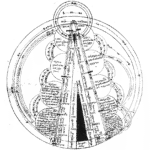
This regressive and transformational process, the Body Map’s Return Cycles (Figure 1), was first articulated by Ruumet (1997, 2006) and expanded here. From the perspective of forward development, Figure 1 illustrates the Return Cycles integrating Axes 6 through 10 with Axes 5 through 1, respectively:
• Return Cycle paired with Axis 6, Compassion Body → Axis 5, Competence Body
• Return Cycle paired with Axis 7, Presence Body → Axis 4, Belongingness Body
• Return Cycle paired with Axis 8, Awareness Body → Axis 3, Pleasure Body
• Return Cycle paired with Axis 9, Awakening Body → Axis 2, Vigilance Body
• Return Cycle paired with Axis 10, Enlightenment Body → Axis 1, Archetypal Body
Each Return Cycle transforms a more rudimentary form of embodiment at progressively lower axes.
Therefore, claim your Ring!
In the Spirit of Adventure, The Guide