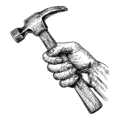
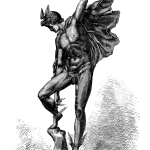
Hermes invented several tools and tricks, among them the lyre, the alphabet, numbers, and various forms of measurement.
Hermes is one of the most significant gods in Greek mythology, known as the messenger of the gods. His Roman equivalent is Mercury. Hermes is the god of trade, wealth, luck, fertility, animal husbandry, sleep, language, thieves, and travel. He is often depicted as a youthful and athletic figure, adorned with winged sandals (talaria), a winged hat (petasos), and carrying a herald’s staff (caduceus), which is a short staff entwined by two serpents.
Attributes & Symbols
→ Winged Sandals (Talaria): These allow Hermes to fly and move swiftly.
→ Caduceus: A staff with two serpents intertwined, often mistakenly associated with medicine. It signifies his role as a herald and messenger.
→ Petasos: A winged hat that grants him speed and invisibility.
→ Tortoise Shell Lyre: According to myth, Hermes invented the lyre from a tortoise shell.
Roles and Responsibilities
→ Messenger of the Gods: Hermes acts as a conduit between the divine and mortal worlds, delivering messages and guiding souls to the underworld (psychopomp).
→ Protector of Travelers: He safeguards those on journeys, ensuring their safety.
→ Guide of Souls: Hermes leads souls to the afterlife, a role known as psychopomp.
→ Inventor and Trickster: Known for his cleverness, Hermes invented several items and tricks, including the lyre, the alphabet, numbers, and various forms of measurement.
Myths and Stories
→ Birth: Hermes was born to Zeus and the nymph Maia. As an infant, he displayed remarkable cunning by stealing Apollo’s cattle and inventing the lyre to placate his brother’s anger.
→ Role in the Iliad and Odyssey: In the Iliad, Hermes assists in guiding Priam to Achilles’ tent to retrieve Hector’s body. In the Odyssey, he aids Odysseus by giving him the herb moly to protect against Circe’s magic.
→ Relationship with Other Gods: Hermes maintains favorable relationships with most gods, often acting as a mediator and helper. He is particularly close to Apollo and Athena.
Etymology
The etymology of Hermes’ name is uncertain, but several theories exist:
→ From the Greek Word “Herma”: This term refers to a heap of stones or boundary markers, which were often associated with Hermes as a guide and protector of travelers.
→ Link to Indo-European Roots: Some scholars propose a connection to the Proto-Indo-European root *ser-, meaning “to bind” or “to put together,” reflecting his role in communication and exchange.
→ Related to “Hermeneutics”: The word hermeneutics, the study of interpretation, is derived from Hermes, emphasizing his role as a messenger and interpreter of divine will.
Hermes’ dynamic and multifaceted nature makes him one of the most intriguing and revered deities in Greek mythology. He embodies the qualities of agility, eloquence, and wit, serving as a bridge between the mortal and divine realms.
The word ‘Hermeneutics,’ meaning the study of interpretation, is derived from Hermes, emphasizing his role as the messenger of the gods and interpreter of divine will.
In the Spirit of Adventure, The Guide