In a world that seems increasingly fragmented, relativized, and disoriented, it is worth returning to the foundation stones of human flourishing: the Good, the True, and the Beautiful. For Aristotle, these were not only abstract ideals, but interwoven dimensions of a unified life—ethical, rational, and aesthetic threads braided together into the wholeness of being (ontology). Each represents an axis of reality: the Good answers to purpose (telos), the True to correspondence (aletheia), and the Beautiful to harmony (to kalon). To understand them in unity is to touch something of the divine order woven into both cosmos and soul.
Central to this unity is logos—the rational principle of order, measure, and meaning. Logos is not merely logic; it is the structuring intelligence that renders reality knowable and purposeful. It is what shapes matter into form, chaos into cosmos, impulse into virtue. To live by logos is to bring one’s life into accord with the intelligible and ordered nature of reality—this, for Aristotle, is what makes human flourishing possible.
The triad of the Good, the True, and the Beautiful are not isolated values; they co-arise. What is truly good will not contradict what is true; what is truly beautiful will not be at odds with goodness. Their unity is neither arbitrary nor subjective—it reflects something metaphysical. In Aristotle’s world, these values are grounded in the nature of things: the good horse runs well, the true statement matches reality, the beautiful statue embodies proportion and vitality. They are objective, grounded not in preference but in participation with logos.
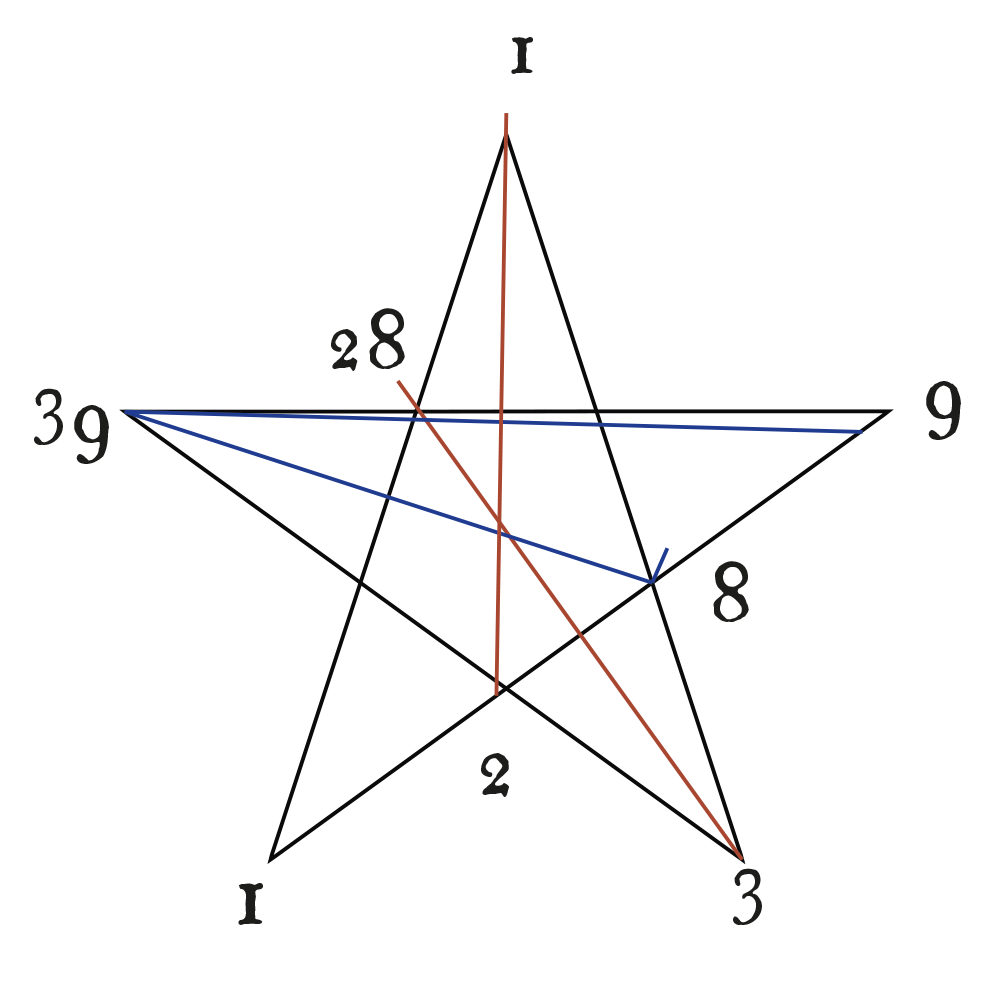
Here enters the pent-alpha—a symbol that quietly contains the entire philosophical architecture of this worldview. The five-pointed star formed of five interlocking Greek alpha characters is more than geometric ornament. It encodes the golden mean (φ), that mysterious ratio found throughout nature—from the spiral of galaxies to the growth pattern of sunflowers. The pent-alpha is a symbol of proportional perfection, expressing the same mathematical truths that nature builds into bone, leaf, and shell. Its beauty arises from its truth; its truth arises from its fidelity to the good form.
In this sense, the pent-alpha stands not just for aesthetic balance, but for ontological alignment. It is the star of the golden mean—a harmony between extremes, a symmetry between chaos and order. This, too, is Aristotle’s ethic: the virtue that lies in the mean between excess and deficiency. The golden ratio is not just a formula for beauty—it is an emblem of sophrosyne, of temperance, of the good life lived in measured proportion.
To stand for these values today—Goodness, Truth, Beauty, Logos, Proportion—is to take an unpopular stand. It is to assert that not all truths are equal, that beauty is not merely taste, that goodness is not a matter of convenience. It is to live in resistance to nihilism and cynicism, and to affirm that reality has structure—and that structure is worth aligning with.
Such alignment is not passive. It requires courage—a kind of moral bravery to live by eternal standards in a time of shifting norms. To stand for the triad of values symbolized by the pent-alpha is to make a philosophical and ethical declaration: that we are not arbiters of truth, but its seekers; not inventors of goodness, but its servants; not creators of beauty, but its revealers.
Aristotle taught that the life of virtue was a life in accordance with logos, and that such a life would be beautiful, truthful, and good—not merely in parts, but as a whole. The pent-alpha, then, becomes a modern emblem of an ancient ideal: a star to orient us, a shape to remind us that proportion is not a constraint but a path to flourishing.
And so, we might begin again—not with noise or novelty, but with measure, meaning, and moral clarity. We begin with the eternal forms—Goodness, Truth, and Beauty—as the first coordinates of a sane and luminous life. And we draw the star with care, in both mind and deed.
In The Spirit of Adventure, The Guide