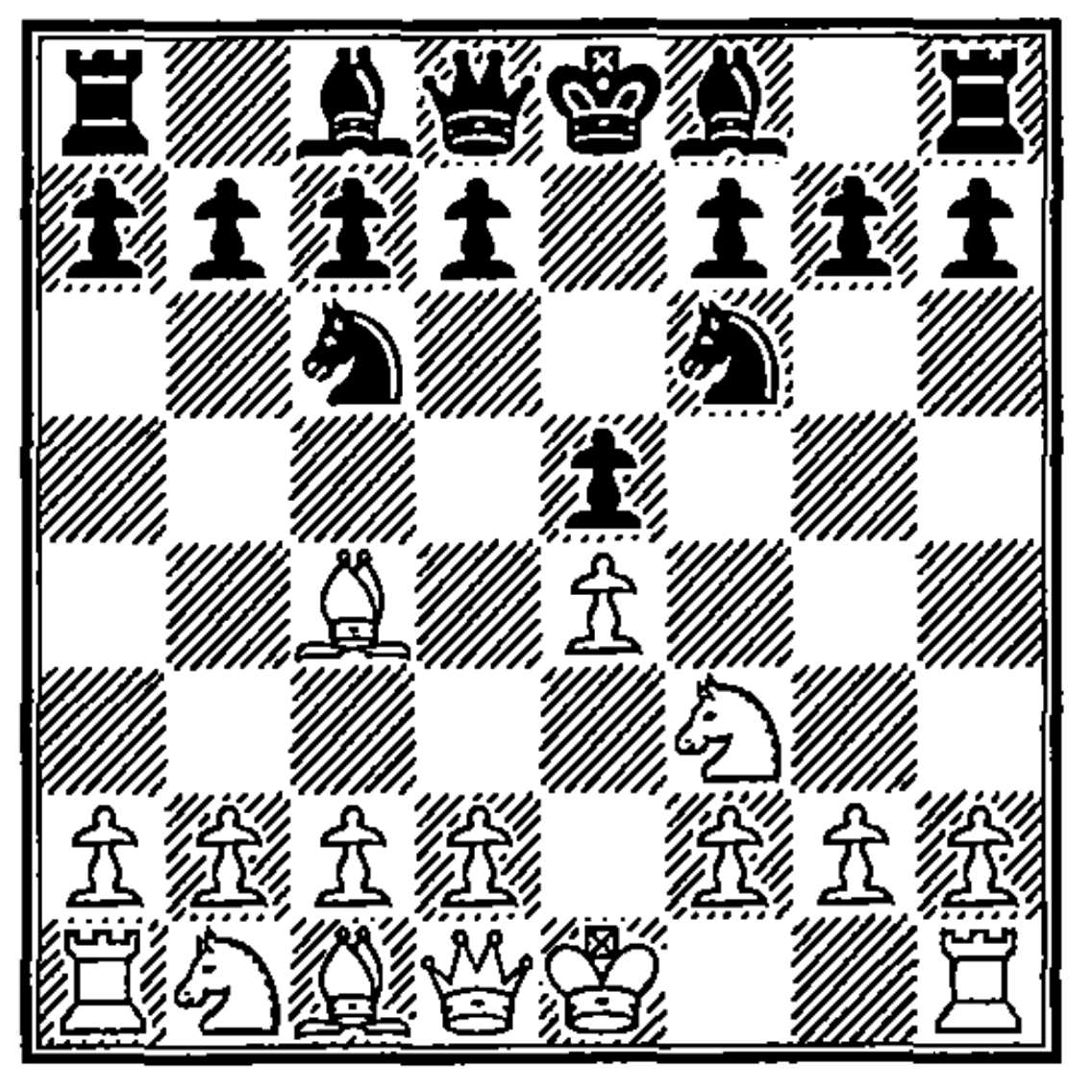
I: TWO KNIGHTS DEFENSE’
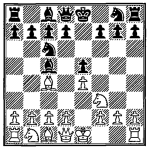
1 e4 e5 2 Nf3 Nc6 3 Bc4 Nf6
WE:
”
BLACK ISSUES A CHALLENGE With his/her third move when playing the Two Knights’ Defense. Already White is confronted with the choice of winning a pawn and entering complex play or allowing Black to get away with provocative play. This bold choice of opening can be psychologically motivated to draw the opponent into battle, as a statement that peaceful simple play will be avoided.
The Two Knights’ is one of the oldest of openings, dating to 1580 when it was subjected to analysis by Polerio. Its reputation through history has remained good with the leading masters. One hundred years ago the great Tarrasch called 4 Ng5 (the attempt to refute the opening) “einstumper zug”—a beginner’s move. White has developed two pieces and proceeds to crudely attack with them—obviously not correct strategy. Yet Steinitz believed otherwise and modern theory respects the gain of a pawn, though likewise acknowledging the gain of development Black obtains in return. Thus the critical line has mixed reviews, but Black will be happy then if he/she is seeking a fighting, unclear game. Grandmasters of aggressive temperament have never been afraid to use this defense, but calm, positional players of all strengths would probably prefer to play the Giuoco Piano.
The direct 4 Ng5 is the subject of columns 1—12. The most usual response is 4…d5 5 exd5 Na5 (columns 1-8). Columns 1-6 is the main line 6 Bb51t c6 7 dxc6 bxc6 8 Be2 h6, when White must decide on which square to retreat his knight to. 9 Nf3 (columns 1-4) allows . ..e4 with the initiative, while Nh3 (columns 5 and 6) is on the side of the board and al-
lows Black the opportunity to double White’s pawns. Still, White is a pawn ahead and Black must show compensation for it. Columns 7 and 8 are lesser played lines after 5 …Na5. Column 9 is the Fritz Variation, 4… d5 5 exd4 Nda4 (the Fried Liver Attack is covered in note (k). The Ulvestad Variation (5 …b5) is column 10. The fantastic Wilkes-Barre Variation in which Black simply ignores the threat on f7 with 4… Bc5 is seen in columns 11-12. These lines are for the adventurous.
White seeks development instead of material with 4 d4, the subject of columns 13—20. The Max Lange Attack, 4… exd4 5 0-0 Bc5 is covered in columns 13—15, while 5 …Nxe4 is columns 16—18. The Max Lange leads to more complicated play, while 5…Nxe4 tends to simplicity. White’s attempt to avoid these lines with 5 e5 comprises columns 19—20.
This line sees use from grandmasters, but Black’s chances are reasonable. Columns 21-23 are an attempt by White to quiet the position with 4 d3. This is really quite a reasonable move, even if it looks as if it is played just
to avoid complexities. Play can either transpose into a positional game of maneuver, or Black can try to liven the game up with an early …d5—though this is a little risky. Column 24 covers 4 Nc3, which allows Black to equalize pretty easily with 4 …Nxe4.
”
IT:
It’s: