A Critique of Metamodern Misuse — And an Invitation to Real Dialogue
What does it truly mean to be Faustian? The question hit me hard when I saw the term deployed in Metamodern discussions, echoing Hanzi Freinacht’s The Listening Society:
“With the advent and development of agriculture we have what I call a faustian age; symbol-stage C. I call it ‘faustian’ because people can now reach for power, glory, and mastery over others through organized violence and accumulation of military prowess — controlling territories, resources, and populations. Like in the story about Faust, you can ‘sell your soul’ for ascension and power.”
This framing reduces Goethe’s Faust to a cartoonish morality tale of violent domination and soul-selling. It’s not just inaccurate — it’s a vile misreading that flattens one of Western literature’s deepest explorations of human striving into a scapegoat for pre-modern pathologies.
The real Faust is no bargain-basement power-grabber. He’s a scholar who has mastered every discipline — medicine, law, philosophy, theology — yet finds it all sterile:
“Medicine, law, and philosophy — you’ve worked your way through every school… You’re no wiser now than you were before… there’s nothing we can ever know.”
This is Socrates’ wisdom: knowing that you know nothing, rejecting self-delusion. Faust’s crisis is existential — he’s trapped in conventional programming, lip-service admiration, instrumental knowledge. He turns to magic not for domination, but to break free: “A dog could stand this life no more. And so, I turn to magic lore.”
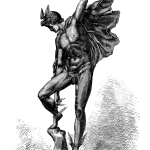
Enter Mephistopheles (the poodle’s core) — not through a crude pact, but a wager. Faust bets his soul that no moment of satisfaction will ever make him say, “Verweile doch! du bist so schön!” (“Tarry a while! Thou art so fair!”). If any experience lulls him into contentment, the devil wins. This is the Faustian wager at its purest: the ultimate subject-object merge.
Subject (Faust): The restless “I AM” — endlessly dissatisfied, staking identity on perpetual striving. He defines the terms: satisfaction = defeat.
Object (Mephistopheles + the unleashed world): The devil as active antagonist — cynical, seductive, delivering temptations (Gretchen’s love, Helen’s beauty, political power, grand projects). These objects push back fiercely: love turns tragic, beauty proves fleeting, power brings guilt. No passive symbols — they wound, tempt, force evolution.
Dialectical fire: Every clash generates consequence. Friction forges transformation. Faust is scarred (Gretchen’s madness, infanticide), propelled forward (scholar → lover → ruler → visionary engineer). Synthesis emerges: endless dissatisfaction redeems him. Angels declare his soul saved because striving itself affirms life. The wager births the integrated self — not through evasion or domination, but through direct crash with reality.
This is shadow integration: Faust translates “In the beginning was the Word” into “In the beginning was the Deed (Act).” He transcends good/evil dichotomies (Nietzsche’s Beyond Good and Evil), sees Mephisto as “a part of that same power that would forever work for evil, yet forever creates good.” No demonizing — the devil mirrors his own negation, perpetual becoming.
In developmental terms (Cook-Greuter, Torbert), Faust moves post-conventional: from self-delusion to Magician/Construct-Aware→Ironist/Unitive. He integrates the spiral, grasps microcosm-macrocosm, creates a Magnum Opus — unifying opposites into inspired culture. This is Nietzsche’s Übermensch via Goethe: not megalomania, but holistic realization. In Wilberian language, full second-tier entry: no aborting self-actualization, no existential collapse — just synthesis.
Freinacht’s “Faustian” as agricultural-era violence/power-hoarding misses this entirely. It weaponizes the term against pre-modern stages while ignoring Goethe’s vision: striving redeems when it’s purposeful, not destructive. Faust builds an enlightened society in Part II — not through conquest, but visionary engineering. Knowledge applied, sensuality deepened into genuine love, power channeled nobly.
The wager echoes in personal risks: staking everything on collision — blind investments igniting chaos/glitch-faith, marriage as invocation, raw rituals forcing presence. The object bites back (vertigo, betrayal, humiliation), but rebirth follows. No circling despair — just striving that affirms the “I AM” through fire.
Goethe spent ~60 years on Faust (Part I 1808, Part II 1831, before his 1832 death). It’s grammatical poetry mapping the psyche, the adventure, the mirroring between microcosm-macrocosm.
My advice: Be brave, not a chicken. Stop divisive labeling — it’s the real pathology. Heal the soul, embrace the holistic self, witness the unitive through action/non-action (Kant’s categorical imperative). Realization is verb, not destination.
I invite honest dialogue with Hanzi Freinacht and metamodern circles: Why perpetuate this misreading? What might we learn from each other? A wager maybe?
In the spirit of adventure,
BraveDave