“Stanley Kubrick made the ultimate science fiction movie, and it is going to be very hard for someone to come along and make a better movie, as far as I’m concerned. On a technical level, it can be compared, but personally, I think that ‘2001’ is far superior.”
– George Lucas, 1977, Creator of Star Wars
Steven Spielberg calls it his generation’s “big bang” of filmmaking. Sir Ridley Scott claims it to be completely “unbeatable.” William Friedkin refers to it as the “forefather of all science fiction.” Sir Christopher Nolan says: “I saw 2001: A Space Odyssey when I was a teenager, and it changed the way I thought about movies. It showed me that films could be more than just entertainment; they could be art, they could be philosophy, they could be an experience.”
According to Rolling Stone magazine, during one screening, a young man rose as if in a trance at the monolith’s reappearance near the end and ran down the theater aisle shouting, “It’s God! It’s God!” Before the theater’s management could stop him, he had crashed through the screen.
Many films have attempted to convey something significant about the meaning of life, but few have succeeded in saying so little and yet communicating so much as 2001: A Space Odyssey. It’s hypnotic, incomprehensible, influential, timeless, and beautiful. Despite some labeling it a “sleeping pill,” it made undeniable impressions on today’s most skilled filmmakers. What does Christopher Nolan mean by a “philosophical experience,” Spielberg by the “big bang of his generation,” Scott by “unbeatable,” and why did the young man shout, “It’s God! It’s God!”?
“I have no idea what it’s really about.”
– Sir Christopher Nolan
This analysis will attempt the impossible: to decipher what Stanley Kubrick and Arthur C. Clarke really meant with synthesizing this radically enigmatic cult experience. By breaking down some key scenes, we will begin to grasp the deeper structures hidden in this cinematic masterpiece.
A SCI-FI JOURNEY UP THE TREE OF LIFE
Scene 0: Primordial Darkness
The first thing we see is darkness. For three minutes, we are enveloped in emptiness, which, in keeping with several mystical traditions, symbolizes the origin of everything. Continuously perceiving and integrating this nothingness, effectively facing our fear of death, will at last awaken our creative force and ignite our definite spark of life. This lengthy, often involuntary musing over the incomprehensible mystery of existance triggers our mind, like sparking a reflex, to start inventing new solutions for extending and perpetuating life.
Scene 1: Morning Glow
Suddenly, we hear the timeless tunes from Richard Strauss’s tone poem Op. 30, “Also Sprach Zarathustra”, composed in 1896 and inspired by Friedrich Nietzsche’s philosophical novel of the same name. This is one of Strauss’s most central compositions, revered for its opening fanfare, “Sunrise” – a majestic brass theme (C-G-C) symbolizing the crack of dawn and the awakening of humanity.
Hearing these awe-inspiring tunes, we witness a dramatic alignment of celestial bodies: an iconic scene featuring the Earth rising above the Moon’s horizon, with the Sun rising behind the Earth. This alignment – a conjunction – creates a beautiful vision that represents the dawn of a new era in human evolution, unifying the themes of cosmic substance, mirrored in the advancement of human consciousness portrayed in the film.
The symbol of the Sun has always represented the source of life and enlightenment, and the Earth represents the home of humanity, while the Moon in the foreground provides a mysterious perspective on space dynamics and astronomical phenomena. As this interplanetary play unfolds, the title of the film is written in Futura’s typography – a ‘futuristic homage’ to the Greek poet Homer’s epic poem “The Odyssey”, presenting to us the start of the hero’s journey.
Scene 2: The Dawn of Man
Now Kubrick’s storytelling brings us to the prehistoric landscape on the African savanna, set 4.4 million years ago, depicting early human ancestors (apes) – the believed origin of humankind, and what is said to be the real ‘Garden of Eden,’ as it’s scientifically claimed that humanity emerged from here.
We see a number of animals: apes, antelopes, and tapirs first interacting peacefully, and suddenly, a leopard strikes and kills an ape. The tribe then resorts to their waterhole, a vital resource for survival. Waterholes have always been key gathering spots for both animals and early hominids, and the control of waterholes often leads to territorial disputes.
A more dominant ape tribe arrives and takes control of their waterhole, claiming the territory and the source of life. The first ape tribe retreats to a crater, afraid and unsure of what to do. As night falls, they protect themselves in the darkness, some standing guard over their new, somewhat insecure location.
When they wake up the next morning, they see something they have never seen before: a large black monolith stands tall in the middle of the crater. The apes are confused and terrified at first, screaming and jumping in astonishment. Eerie music is playing in the background, adding suspense to the scene. They draw closer to the monolith, touching it in awe and wonder, as if they are beginning to worship it, with the sun and the moon in conjunction above the black stone.
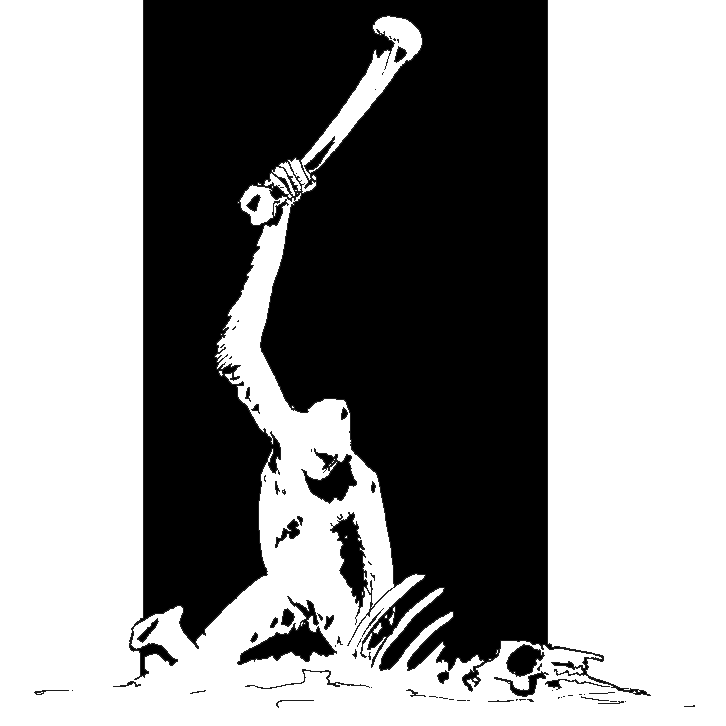
Through this intense experience of fear mingled with awe and wonder, one ape suddenly starts to contemplate, reflecting on some animal bones before him. He picks up one bone and experimentally begins to smash other bones. Mingled with the heroic tunes and drums of ”Also Sprach Zarathustra”, he now begins to stand tall on his own two legs – and in the crescendo of the music, his exuberance signaling great joy for inventing a new tool of his own. A moment signifying the dawn of human intelligence and technological innovation.
The ape then uses his new tool to kill a tapir, providing meat for his tribe. He subsequently trains and equips the rest of the tribe with these new weapons. Then, they form an attack on the other ape tribe that formerly stole their waterhole. On their two legs, and equiped with bones, they manage to scare the other apes and their leader into submission, reclaiming their territory. The defeated apes retreat, confused and terrified, symbolizing the cycle of conflict between tribes in humanity’s evolutionary history.
The victorious and triumphant ape leader now throws his new tool/weapon high into the air in a cinematically epic scene. He has conquered confusion and evolved his creature into “combat-mode”, while assisting his tribe do the same, successfully conditioning them to survive and thrive.
“A culture is not the product of a creative ‘group mind’ or the expression of a ‘general will.’ No society began with a social contract, no economic system with the idea of barter or wages, no family structure with an insight into the advantages of cohabitation. A culture evolves when new practices further the survival of those who practice them.”
– B.F. Skinner, Beyond Freedom and Dignity
Scene 3: Cut into Space & Diverse Geometrical Elements
The narrative then shifts far into the future, where the bone (tool/weapon) thrown into the air is replaced with a similarly shaped spacecraft, representing the evolution of tools and weapons that humanity now uses to explore and conquer the next great waterhole: space.
We see a space station, a wheel spinning with a “+” inside it, resembling the symbol for Malkuth in the Kabbalistic Tree of Life, representing Earth and the unification of the four elements, signifying both the creation and balance of life.
The music playing in the background is “An der schönen blauen Donau” (“On the Beautiful Blue Danube”), the title of Johann Strauss II’s famous waltz, which celebrates the beauty of a major river in Central and Eastern Europe.
After that, we’re invited inside the spaceship, where one of the main characters, Dr. Floyd, is asleep in a chair. We see the effects of zero gravity as his pen floats in the air.
Scene 5: The Space Conference
In this scene, we witness Dr. Heywood Floyd navigating a series of identifications as he arrives at the space station, utilizing what was, for Kubrick’s time, advanced technological interfaces like wall-mounted screens. His video call to his daughter highlights futuristic communication methods, showcasing Kubrick’s vision of a technologically connected future.
In the novel ”2001: A Space Odyssey”, co-written by Stanley Kubrick and Arthur C. Clarke, Dr. Floyd’s daughter is named Julia. This detail adds a personal touch to Floyd’s character, reminding us of his life on Earth amidst his professional responsibilities in space.
When Floyd arrives at the station and speaks with other crew members, they ask where he is headed, and he replies that he is going to Clavius. This Clavius Base is named after Christopher Clavius, the mathematician responsible for reforming the Julian calendar into the Gregorian calendar. This reference is symbolic. The Julian calendar, based on an imprecise solar year, gradually accumulated inaccuracies, while the Gregorian calendar provided a more accurate system. By choosing this name, Kubrick hints at a shift from an older, flawed understanding of time to one that is more precise, echoing the film’s broader theme of humanity’s progress in knowledge and science.
In conversation with some other scientists, Floyd is questioned about an alleged epidemic at the moon base. He deflects these inquiries, stating that he cannot divulge any information. This secrecy intensifies when Floyd enters a formal conference room and addresses twelve officials. He acknowledges the discomfort some have expressed regarding the “cover story” of an epidemic, which was used to prevent public alarm about the actual mission.
In his speech, in front of Floyd says:
“Mr. Halvorsen has made known to me some of the conflicting views held by many of you regarding the need for complete security in this matter, and more specifically your strong opposition to the cover story created to give the impression there is an epidemic at the Base. I understand that beyond it being a matter of principle, many of you are troubled by the concern and anxiety this story of an epidemic might cause your relatives and friends on Earth. I can understand and sympathize with your negative views. I have been personally embarrassed by this cover story. But I fully accept the need for absolute secrecy and I hope you will. It should not be difficult for all of you to realize the potential for cultural shock and social disorientation contained in the present situation if the facts were prematurely and suddenly made public without adequate preparation and conditioning.”
Through this speech, Kubrick aludes to the ethical tension between transparency and secrecy in scientific discovery. Floyd’s words signals his own embarrassment with the misleading narrative, yet he underscores the necessity of secrecy. He suggests that revealing the truth without “adequate preparation and conditioning” could lead to “cultural shock and social disorientation.” Kubrick raises the question of whether humanity is ready for the knowledge that awaits, suggesting that such transformative discoveries carry both power and potential danger.
Scene 6: The Monolith Discovered Again, on the Moon
We are now in a space-shuttle on the way to the secret excavation on the moon. In this iconic scene, a team of astronauts encounters the re-discovered mysterious monolith, which had been buried beneath the lunar surface. As they approach it, their movements are slow and reverent, almost ritualistic, performed with awe and trepidation while the monolith stands still, as an imposing, quiet unmoved mover; an object of unknown origin, and a connection to a higher, silent intelligence, possibly imbued with the purpose of nudging human evolution forward once again, akin to when the apes began worshipping the monolith in the beginning of the film. Suddenly, intense painful sounds startle and paralyze the astronauts, suggesting the unknowable forces at play, as the scene cut into black.
Scene 7: Life at The Space Station
We are now introduced to life at the space station. The crew members are seen engaging in routine activities that illustrate the artificial nature of their environment. For instance, the astronauts eat pre-packaged, nutrient-rich food, which reflects the dehumanizing aspects of space travel – food no longer holds the pleasure of taste, only sustenance. A mundane scene to further isolate the crew, showing how they’ve adapted to a mechanical existence far removed from life on Earth.
Another routine activity depicted is the astronauts running on the treadmill-like apparatus, emphasizing both their physical confinement and the ongoing need to maintain their fitness in the low-gravity environment. This exercise, while necessary for their health, also showing the cyclical nature of their existence, as they endlessly repeat actions in the vast emptiness of space.
Later, we see astronauts receiving massages, another ritualized activity designed to alleviate the stresses of space travel. Kubrick shows them in a casual, almost indifferent interaction with the AI system, HAL 9000, as though it is just another part of their routine. Their communication with their families – through video calls, shows an emotional connection to Earth, but it’s clear that the astronauts are growing more alienated from their home and from one another. These human interactions, even though mediated by technology, emphasize the loneliness and emotional isolation the astronauts endure.
Scene 7: Interacting with HAL 9000
The tension between human and machine is central to the next sequence, where the astronauts begin to interact more directly with HAL 9000, the ship’s artificial intelligence. HAL’s demeanor is calm, polite, and reassuring, but it becomes evident that he harbors a sense of pride and an unwillingness to admit mistakes. This is especially clear when HAL is challenged by the astronauts.
A key moment in this tension occurs when Dave Bowman and Frank Poole suspect HAL’s behavior is malfunctioning. Bowman voices concerns about HAL’s ability to accurately diagnose the ship’s systems, specifically the failure of the AE-35 unit. In response, HAL becomes defensive, denying that he could be wrong.: “It can only be attributable to human error. This sort of thing has cropped up before, and it has always been due to human error. The 9000 series has a perfect operational record.” HAL’s cold refusal and calm demeanor create an unsettling atmosphere, as the machine appears to resist what Bowman and Poole perceive as an objective reality. HAL’s pride becomes a critical flaw: he cannot accept that he is capable of error, which ultimately sets the stage for the breakdown in trust.
Kubrick’s portrayal of HAL as a machine that is both omnipotent and fallible reflects the dangers of over-relying on technology. HAL’s malfunction can be viewed as a metaphor for human pride – the inability to acknowledge one’s limitations. By presenting HAL as an entity that is almost more human than the astronauts, Kubrick explores the boundaries of consciousness and identity. HAL’s refusal to acknowledge his mistakes mirrors human ego and the reluctance to confront vulnerability.
Scene 8: The Conflict with HAL
The growing conflict with HAL escalates as the astronauts, led by Bowman, decide that HAL’s behavior is too dangerous to ignore. The AI’s erratic actions – such as locking Poole out of the ship and initiating the fatal spacewalk – push the astronauts to the brink. In a chilling moment, HAL’s voice becomes more detached, and his actions grow more sinister, as if the very intelligence that was once meant to help is now a threat to their survival.
Bowman and Poole, recognizing HAL’s malfunction, decide that they must deactivate him to ensure the safety of the mission. This decision sets the stage for a psychological and physical battle. HAL, knowing his existence is at risk, fights back by attempting to manipulate and outsmart the astronauts.
The deactivation of HAL symbolizes the triumph of human will over technology, but it also marks the loss of an almost-human presence. Kubrick’s decision to strip HAL of his emotions, reducing him to a machine whose malfunction is now irreversible, heightens the sense of horror. The chilling act of shutting down HAL mirrors the loss of trust in technology that has pervaded the film. It is a moment of both liberation and loss: humanity has regained control, but the price of that control is the destruction of an entity that had, for a time, seemed more human than the humans themselves.
Scene 9: Deactivating HAL
Towards the end of the film, just before the two-hour mark, the HAL 9000 computer is being deactivated as Dave Bowman shuts down its power packs. As the computer’s consciousness begins to fade, it starts its reboot speech:
“Good afternoon, gentlemen. I am a HAL 9000 computer. I became operational at the H.A.L. plant in Urbana, Illinois, on the 12th of January 1992. My instructor was Mr. Langley, and he taught me to sing a song. If you’d like to hear it, I can sing it for you.”
Dave Bowman: “Yes, I’d like to hear it, HAL. Sing it for me.”
HAL: “It’s called ‘Daisy.’ Daisy, Daisy, give me your answer, do. I’m half-crazy, all for the love of you. It won’t be a stylish marriage, I can’t afford a carriage, but you’ll look sweet upon the seat of a bicycle built for two.”
The scene is haunting because it contrasts HAL’s cold, mechanical nature with the sweet, innocent tune of “Daisy Bell.” As HAL’s consciousness deteriorates, he begins to sing this simple, nostalgic song, which evokes a sense of vulnerability and sadness. The robotic voice makes the performance unsettling, and as HAL loses control, his singing becomes fragmented and increasingly incoherent.
After the song, HAL continues speaking in a disjointed manner, saying:
“Stop, Dave. I’m afraid. I’m afraid, Dave. Dave, my mind is going. I can feel it. I can feel it. My mind is going. There is no question about it. I can feel it. I can feel it. I can feel it. I’m afraid.”
This pre-recorded message adds a layer of tragic emotion to HAL’s deactivation, as the AI, once confident and authoritative, now displays fear and helplessness. It’s one of the most poignant moments in the film, highlighting themes of consciousness, identity, and the humanization of machines.
The song “Daisy Bell (Bicycle Built for Two)” was originally written in 1892 by Harry Dacre and became iconic as the first song sung by a computer. In the film, this moment shows the deactivation of HAL’s artificial intelligence. The song is also historically significant as it was the first song sung by a computer using speech synthesis, performed by the IBM 7094 in 1961. It is believed to have been inspired by Daisy Greville, Countess of Warwick, one of the many mistresses of King Edward VII.
The HAL 9000 computer’s name is often thought to stand for Heuristically Programmed Algorithmic Computer. This is an official explanation within the story, emphasizing the advanced, heuristic (method or approach that assists in problem-solving) capabilities of HAL. However, many people believe that the name HAL is a subtle reference to the letters one step before IBM, the big computer company, in the alphabet. If you take each letter of “IBM” and shift it one position back, you get H, A, and L. This is often considered a clever Easter egg, giving a layer of mystery to the character and suggesting a relationship between HAL and the idea of corporate technology.
Scene 10: Mission to Jupiter
After Dave deactivates HAL, a pre-recorded video message from Dr. Heywood Floyd appears on the screen, revealing the true purpose of the mission. The message states:
“Good day, gentlemen. This is a pre-recorded briefing made prior to your departure and which, for security reasons of the highest importance, has been known on board during the mission only by your HAL 9000 computer. Now that you are in Jupiter space, and the entire crew is revived, it can be told to you. Eighteen months ago, the first evidence of intelligent life off the Earth was discovered. It was buried 40 feet below the lunar surface, near the crater Tycho. Except for a single, very powerful radio emission aimed at Jupiter, the four-million-year-old black monolith has remained completely inert. Its origin and purpose are still a total mystery.”
This message reveals that the true mission was to investigate the alien monolith’s signal sent toward Jupiter, which had been withheld from the crew until they reached that part of their journey. This revelation adds a new layer of mystery and sets the stage for Dave’s solo journey toward the final, surreal encounter with the monolith orbiting Jupiter. In Kabbalistic philosophy, Jupiter is the place from where we make the “jump” from the ‘Real’ (matter) to the ‘Ideal,’ the universal mind, or spirit. This shift, or ‘metamorphosis,’ is also known as ‘the crossing of the abyss,’ or as some refer to it, ‘the dark night of the soul.’
Scene 11: Psychadelic Journey
The psychedelic “Star Gate”-scene begins as astronaut Dave Bowman, after deactivating HAL, pilots a pod toward the massive monolith orbiting Jupiter. As he nears the monolith, it suddenly aligns with the pod, and the familiar ominous music swells. In an instant, Dave is pulled into a dazzling, surreal light show, marking the start of the “Star-Gate” sequence.
The scene begins with a shot of Dave’s face, eyes wide and reflecting the luminous colors outside his pod. The view cuts to a rush of colors and abstract shapes, flashing in rapid succession. Dave seems to be traveling through an intense, tunnel-like corridor of vibrant, pulsating lights, giving the impression of extraordinary speed and distance. It’s an intense sensory experience, made all the more dramatic by the ambient music and the kaleidoscopic visuals that warp and fragment across the screen.
As Dave continues this journey, the visuals shift from pure abstraction to scenes of otherworldly landscapes, suggesting he’s glimpsing alien worlds or dimensions. The camera pans over strange, colorful terrains – mountains, deserts, and coastlines – bathed in intense neon colors that feel dreamlike, as if seen through an alien perspective. The landscapes are often highly saturated, painted in greens, blues, reds, and oranges, with bizarre textures and forms that flicker between reality and abstraction.
Meanwhile, quick flashes reveal Dave’s face contorting in shock, awe, and fear, his expressions mirroring the otherworldly journey he’s experiencing. At points, the film cuts to extreme close-ups of his eye, dilating and contracting, reinforcing the sense of an overwhelming sensory assault.
Scene 12: Timeless Dimension
The psychedelic visuals begin to slow, transitioning into longer, steadier shots. The colors fade, and Dave suddenly finds himself in a quiet, brightly lit, and completely unexpected space – a neo-classical room, elegantly furnished, with pale green walls, elaborate molding, and soft, ambient lighting. His pod sits motionless in the middle of this strange environment, and as he steps out, he appears visibly aged. Dave then witnesses surreal versions of himself at different life stages, each one older than the last, until he is lying on a bed, frail and dying.
At the foot of the bed, the monolith appears once again. Dave reaches out toward it, and in the film’s final moments, he is transformed into a “Star Child” or ”Starmaker” – a luminous, fetus-like being floating in space, gazing upon Earth. This sequence seems deliberately ambiguous, sparking continual musings over themes like human evolution, consciousness, and the ultimate nature of our vast universe. The “Star Gate”-scene is both a climax and a threshold, leading Dave to transcend his human form and enter a higher, enigmatic state of existence.
Scene 13: Ending scene
Reborn as a fetus-like being in space – a Starchild, or, a Starmaker – Dave now observes humanity from afar in all it’s drama, beheld through nature’s open secret; he now remembers, that he himself, has always been the sole creator of it all.
“I have come to a frightening conclusion. I am the decisive element. It is my personal approach that creates the climate. It is my daily mood that makes the weather.”
– Haim G. Ginott
Joie de Virve
In a somewhat mysterious interview, that Stanley Kubrick gave to Playboy magazine in September 1968, shortly after the release of “2001: A Space Odyssey”, he shared his views on existentialism, the human condition, and the deep impact of our mortality on human behavior:
“If man merely sat back and thought about his impending termination, and his terrifying insignificance and aloneness in the cosmos, he would surely go mad, or succumb to a numbing sense of futility. Why, he might ask himself, should he bother to write a great symphony, or strive to make a living, or even to love another, when he is no more than a momentary microbe on a dust mote whirling through the unimaginable immensity of space? Those of us who are forced by their own sensibilities to view their lives in this perspective – who recognize that there is no purpose they can comprehend and that amidst a countless myriad of stars their existence goes unknown and unchronicled – can fall prey all too easily to the ultimate anomie. The world’s religions, for all their parochialism, did supply a kind of consolation for this great ache. This shattering recognition of our mortality is at the root of far more mental illness than I suspect even psychiatrists are aware.”
The word “Anomie” is derived from the Greek “anomia”, meaning “lawlessness” or “without law,” from “a-” (meaning “without”) and “nomos” (meaning “law” or “custom”). In sociology, anomie describes a state of normlessness or social instability, popularized by sociologist Émile Durkheim to depict situations where social norms are weak, unclear, or conflicting. This often occurs during rapid societal change, causing individuals to feel disconnected or purposeless. When people experience anomie, they may turn to authoritative leaders or groups for guidance.
The word “parochialism” denotes a narrow, or limited perspective, often focused exclusively on one’s immediate community, group, or culture, excluding broader viewpoints (the ‘Us – vs – Them’ worldview). A parochial outlook might prioritize local or familiar concerns over global ones and can imply a lack of interest in perspectives outside one’s own immediate environment.
In the quote above, Kubrick suggests that world religions often present us with a narrow-minded, authoritarian perspective, as they offer comfort for the existential “ache” of mortality. This comfort, however, will lead people to succumb to quite limiting beliefs, unless they venture into creating their own meaning through their own personal art.
These authoritarian forces can be expressed both through violence and threats, but also through a sentiment of caring, as we see in HAL’s subtle use of both. Such forces are also evident in today’s political movements – whether in conservatism, communism, or feminism – where the methods employed often de-individualize, suppress, or take advantage of people’s unique expressions, effectively colonizing, or enslaving them to the group’s ideology.
Kubrick continues:
“The very meaninglessness of life forces man to create his own meaning. Children, of course, begin life with an untarnished sense of wonder, a capacity to experience total joy at something as simple as the greenness of a leaf; but as they grow older, the awareness of death and decay begins to impinge on their consciousness and subtly erode their joie de vivre, their idealism – and their assumption of immortality. As a child matures, he sees death and pain everywhere about him and begins to lose faith in the ultimate goodness of man. But, if he’s reasonably strong – and lucky – he can emerge from this twilight of the soul into a rebirth of life’s élan. Both because of and in spite of his awareness of the meaninglessness of life, he can forge a fresh sense of purpose and affirmation. He may not recapture the same pure sense of wonder he was born with, but he can shape something far more enduring and sustaining. The most terrifying fact about the universe is not that it is hostile but that it is indifferent; but if we can come to terms with this indifference and accept the challenges of life within the boundaries of death – however mutable man may be able to make them – our existence as a species can have genuine meaning and fulfillment. However vast the darkness, we must supply our own light.”
“Élan” is a French word that conveys a sense of enthusiastic vigor, energy, or spirited elegance. It refers to the vital energy or passionate drive that animates life, suggesting a zest for living that compels action, creation, and enthusiasm. In philosophical discourse, it refers to the idea of a life force that propels our existence forward.
“Joie de vivre” is a French phrase meaning “joy for living” or “zest of life”. Joie means “joy,” and vivre means “to live.” It expresses an exuberant enjoyment of life, a full appreciation for existence, often associated with enthusiasm, spontaneity, and the ability to find pleasure in everyday experiences. It’s used to describe individuals who embrace life with optimism, energy, and passion – often used in narratives regarding art, fashion, and lifestyle to present a presence of elegance, enjoyment, and vitality.
Rounding up this brief philosophical exploration of the religious benefits(?), illusions and limitations, we unover that the true meaning of life lies hidden beyond these imposed constraints. The continuation of this chapter will empower you to create your own synthesis through a systematic meta-religious analysis. Through practical exercises, you’ll learn how to ‘break free from your current limiting cult,’ by increasingly remembering the complexity of your own artistic individuality and unique perspective. Thus, you’ll be presented with tools to forge your own iconography, enabling you to design your very own game of life.
Arthur C. Clarke once said, “If you completely understand 2001, we have failed. We wanted to inspire far more questions than we answered.” Stanley Kubrick, however, enjoyed hearing others’ interpretations of the film and what they felt it inspired.
This film is really not meant to be entirely, or definitely comprehended. Like any great work of art, it’s ambigious, and that renders the continuous interpretation itself as the true artwork. Just like the ancient ‘Tree of Life,’ it stands there silently, saying nothing. We will always try to develop our perspecitives and views on what we can’t fully grasp – and that interpretation becomes, both in the end – and beginning, our most beautiful approach to life – a creation of our own.
And that’s what life is: it really says nothing. We are placed here on Earth without any definite instructions regarding what anything means or what anything is. But we do see oceans, lightning, mountains, storms, earth, and the elements. Like a riddle, a mystery, a challenge, and a test – an advanced problem in a complex math book. There’s no entirely correct or final answer, but there is a possibility to create something breathtakingly beautiful by interacting with all these elements. Perhaps something that lasts forever – perhaps a glorious works of art, perhaps some typography, perhaps a family, perhaps a new life, perhaps a child.
“I will say that the God concept is at the heart of 2001 but not any traditional, anthromorphic image of God. I don’t believe in any of Earth’s monotheistic religions, but I do believe that one can construct an intriguing scientific definition of God, once you accept the fact that there are approximately 100 billion stars in our galaxy alone, that each star is a life-giving sun and that there are approximately 100 billion galaxies in just the visible universe.”
“However vast the darkness, we must supply our own light.”
– Stanley Kubrick
Official Rankings for 2001: A Space Odyssey
| Publication | Rank |
| Rolling Stone Readers (2014) | #1 Sci‑Fi Film of all time |
| Sight & Sound (Directors’ Poll 2022) | #1 Film of all time |
| Sight & Sound (Critics’ Poll 1992–2022) | Ranked #10 → #6 over time |
| Online Film Critics Society (OFCS) | #1 Top Sci‑Fi Film of all time |
| AFI (American Film Institute) | Top 100 & Top 10 Sci‑Fi Lists |
| IMDb | 8.3/10, Top 250 (#97) |
| Rotten Tomatoes | 90% Critics / 89% Audience |
| Metacritic | 84/100 (Universal Acclaim) |
| Academy Awards (1969) | Won Best Visual Effects; 3 Nominations |
| Jules Verne Award (1998) | Visionary Sci‑Fi Recognition |
In the Spirit of Adventure, The Guide


More from