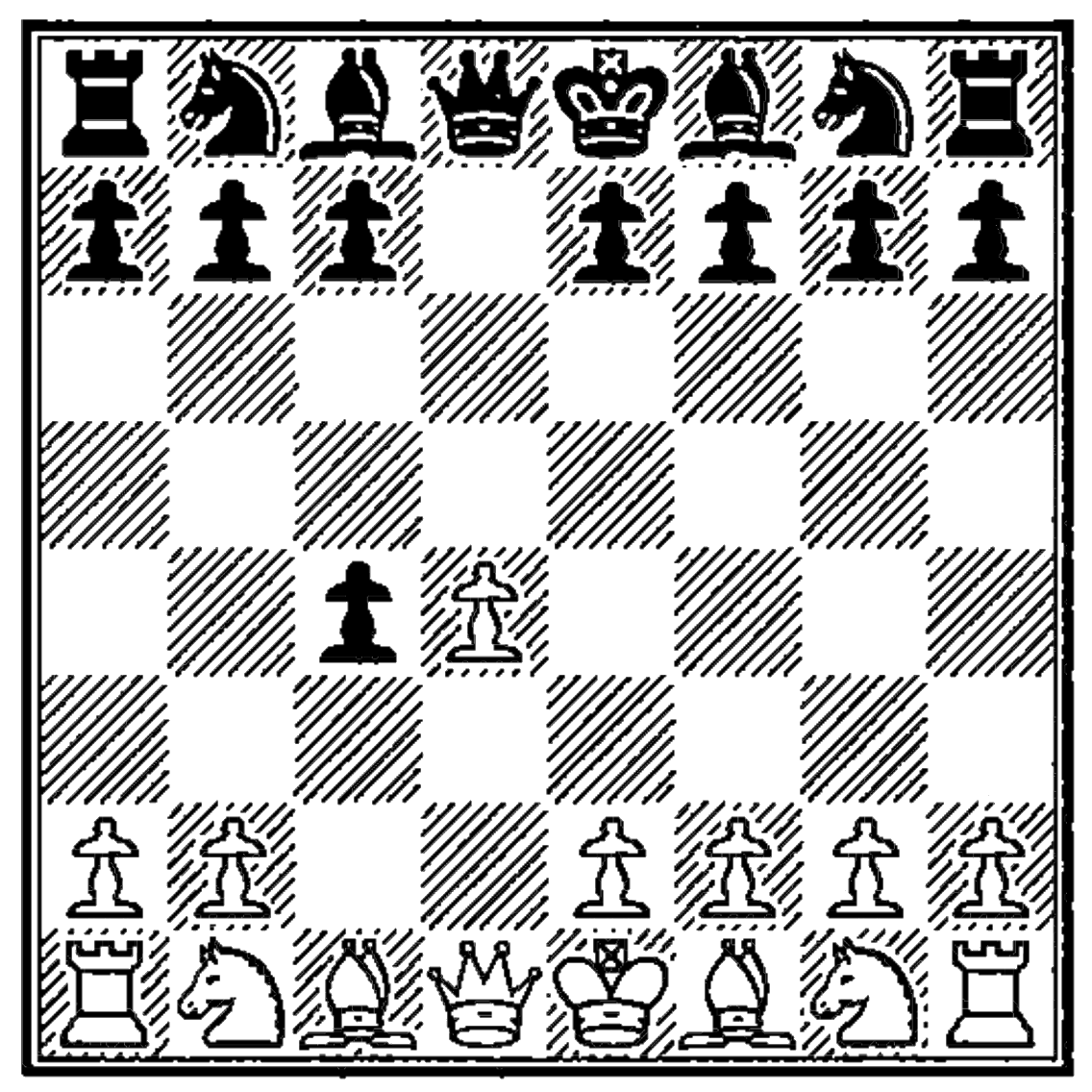
 Queens Gambit Accepted →
1. d4 d5 c4 dxc42.
From Modern Chess Openings →
“The most straightforward defense to a gambit is usually to accept the pawn and make the opponent prove the worth of the sacrifice.
This, however, is not the plan behind accepting the Queen’s Gambit. Attempting to hold on to the pawn usually leads to trouble. Yet, if Black uses the time White takes to recapture the pawn for development, then he/she can count on a safe journey through the opening stage. As opposed to the King’s Gambit Accepted, with its many sacrifices, the Queen’s Gambit Accepted is a safe and solid choice—albeit somewhat stodgy.
The opening dates back to Damiano in 1512. In the early centuries, Black would try to hold on to his/her booty, which gave the opening a bad name. It took until the twentieth century for the modern concept behind 2…dxc4 to come to the fore. Black plays for free development and to saddle White with an isolated d-pawn after …c5 and …cxd4. Black’s “problem child” of the Queen’s Gambit Declined—the light-squared bishop—always finds an active post on g4 or b7 in the Queen’s Gambit Accepted.
The disadvantage of 2…dxc4 is that Black gives up the center. With nothing on d5 blocking the lines, White obtains active pieces and freedom of action. When the isolated pawn arises on d4, White often has good attacking chances, as this pawn may threaten to advance, opening lines of attack. Yet this advance can also lead to wholesale exchanges, producing sterile equality. For this particular reason, the Queen’s Gambit Accepted is considered a rather safe opening.
The main line is 3. Nf3 Nf6 4. e3 e6 5. Bxc4 c5 6. O‑O a6 7. Qe2 (columns 1–6; see diagram above). White plans Rd1, Nc3, and e4 with aggressive play in the center. Black’s usual and best response is 7… b5 (columns 1–5), gaining queenside space and preparing … Bb7. By developing his pieces to flexible, defensive squares, Black should be able to stem White’s initiative. Only against 8. Bd3 (column 5) should Black play an early … cxd4. White obtains an isolated d‑pawn after recapturing exd4, but also gains freedom of movement for his pieces and open lines.
Alternatives to the main line should be considered by White, since Black’s defenses hold up well. 7. a4 (column 7) prevents Black’s queenside expansion but leaves a hole on b4. 7. e4 (column 8) is an interesting pawn offer that Black probably should decline. 6. Qe2 (column 10) prepares to play dxc5 without allowing the exchange of queens—at least a sharp continuation with attacking chances.
The character of the game changes after 4… Bg4 (columns 11–12). Black simply develops his pieces and prepares to reply … Be5 against a later e4. This may grant White extra space, though Black will soften up the central dark squares.
Columns 13–14 cover 4. Nc3, in which White makes a true gambit out of the opening; Black needs to play very accurately. Third‑move alternatives for Black appear in columns 15–18—offbeat lines that lead into different territory but are risky.
Third‑move alternatives for White occupy columns 19–24. Of these, 3. e4 (columns 19–21), immediately advancing in the center, is the most dangerous. Column 24, 3. Nf3 Nf6 4. Qa4+, resembles the Catalan.
”
♟
IF/THEN/ELSE →
The Queen’s Gambit Accepted is not about grabbing a pawn and trying to keep it—
It’s about grabbing time for development and striking back at the center with piece activity.
Opening moves:
d4 d5
c4 dxc4
If you are Black and White plays 1. d4 and 2. c4,
then 2…dxc4 enters the Queen’s Gambit Accepted.
→ You give up central presence temporarily, but gain development time.
If you try to hold the c4 pawn with …b5 or …a6,
then you risk falling behind in development.
Else if you give back the pawn at the right moment,
then you avoid positional traps and reach equality with active pieces.
If you play 3. Nf3 Nf6 4. e3 e6 5. Bxc4 c5 6. O-O a6 7. Qe2,
then you’re in the Main Line of the QGA.
→ White plans Rd1, Nc3, and e4 to build a central initiative.
Black replies with 7…b5, gaining queenside space and preparing …Bb7.
If White plays 8. Bd3,
then Black should strike early with …cxd4,
giving White an isolated d-pawn after exd4.
→ This grants White activity and open lines—but also a long-term target.
VARIATION PATHWAYS – STRUCTURAL DECISIONS
If White plays 7. a4 (instead of Qe2),
then Black’s …b5 is prevented,
but the square b4 becomes a permanent outpost for Black.
If White plays 7. e4,
then this is a bold central pawn offer.
→ Black should likely decline and develop calmly, as accepting may activate White’s center dangerously.
If White delays 6. O-O and instead plays 6. Qe2,
then White avoids early queen trades after dxc5.
→ The line stays sharp with dynamic potential.
If Black plays an early 4…Bg4 instead of 4…e6,
then they simply develop and prepare to meet e4 with …e5.
→ This softens White’s central dark squares but avoids early structural commitment.
If White plays 4. Nc3 instead of 4. e3,
then White makes the Queen’s Gambit a true gambit—risking material for fast activity.
→ Black must play precisely to avoid falling behind.
Offbeat Lines
If Black deviates on move 3 (instead of 3…Nf6),
then the game may enter rarer, riskier waters.
→ These lines (columns 15–18 in MCO) often lead to unbalanced positions but require exact knowledge.
If White plays 3. e4 (instead of 3. Nf3),
→ This is an aggressive attempt to seize space and initiative—Black must defend carefully.
If White plays 4. Qa4+ early,
→ This hybrid with Catalan ideas pressures Black’s queenside and complicates development.
♟
Queen’s Gambit Accepted (Main Line)
d4 d5
c4 dxc4
Nf3 Nf6
e3 e6
Bxc4 c5
O-O a6
Qe2 b5
Bd3 cxd4
exd4 Bb7
Rd1 Nbd7
Typical White plan:
Nc3, Bg5, Rac1, Ne5 or d5 → central control, kingside space, active pieces.
Typical Black plan:
…Bd6, …O-O, …Qb6 or …Rc8 → challenge center, pressure queenside, activate pieces.
♟
What happens when the Queen’s Gambit Accepted works well? →
White’s plan is revealed too early:
By accepting the gambit, Black forces White to show their hand. If White goes all-in on central domination, Black counters with timely …c5, …cxd4, and piece activity.
The bishop problem is solved:
Unlike in the Declined lines, Black’s light-squared bishop can develop freely—usually to g4 or b7—making Black’s setup more harmonious.
It’s solid but not stale:
While the Queen’s Gambit Accepted lacks the fireworks of other gambit openings, it offers stability, clarity, and positional precision—especially suited for players who enjoy clear structures.
Pawn structure trade-off:
White may get an isolated d-pawn—dangerous in attack, but weak in the endgame.
Black can target this with piece coordination and simplified exchanges.
Safe opening = psychological advantage:
When well-prepared, Black neutralizes White’s early initiative and enters an equal—but dynamic—game. You show you’re ready to counterattack with precision, not panic.
♟